It occurred to me, as I was discussing my use of Anki for habit-building with a good friend, that a decent portion of my personal growth is getting dutifully recorded as flash cards. "Why not share the decks?," I thought. "A random soul might find my notes useful, or my friends at least might consider it informative of my strange thought process." Here is a deck of rationality habits, filtered a bit for anything excessively tentative or personal.
Faithful readers, you would do me a great honor if you looked over some part of it and shared with me where you find pleasure, fault, or confusion.
July 10, 2016


April 2, 2016
Testing: How much could I learn on Rosalind.info?
Hello, internet!
If you're curious what I get up to with my time, observe! I ran a little experiment today. This post reports it in a hodgepodge mix of "personal notes" and "terse scientific report".
If you take thirty seconds out of your day to comment, I will owe you one. Please encourage the norm of testing everyday ideas empirically; Be my miniature peer review.
glimpses at other references for algorithmic and data structure fundamentals
Rosalind can sharpen my current skill set some, and do a little more to stretch my limits (mostly in graphs). The vast majority of problems deal in bioinformatics-specific knowledge. If I want to focus on that, the "Bioinformatics Armory" set works would shore up relevant foundations while not wasting time on general skills. This accords with its stated purpose.
Python Village and Algorithmic heights make okay sources for general practice.
If you're curious what I get up to with my time, observe! I ran a little experiment today. This post reports it in a hodgepodge mix of "personal notes" and "terse scientific report".
If you take thirty seconds out of your day to comment, I will owe you one. Please encourage the norm of testing everyday ideas empirically; Be my miniature peer review.
How much would rosalind.info teach me?
I want to know the holes in my knowledge. If Rosalind actually helps, I want to train my internal motivation to prioritize working on it.Hypothesis:
I currently can't do ~70% of problems. My learning trajectory looks unlikely to increase my capability beyond ~%50.Method:
Experiment as proposed Mar 28 - count how many rosalind.info project list I can't do and how many I likely won't learnResources:
Rosalind Problems Listsglimpses at other references for algorithmic and data structure fundamentals
Results:
Apr 2: I ignored Biology Content Knowledge, except where the lack of deep understanding seriously impedes my ability to program the solution.PYTHON VILLAGE 1:0:0BIOINFORMATICS STRONGHOLD 1:1:5
- 6 understand
BIOINFORMATICS ARMORY 2:1:4
- 13 understand
- 14 don't understand yet
- 78 doubt I'll cover
BIOINFORMATICS TEXTBOOK TRACK 1:2:4
- 4 understand
- 2 don't understand yet
- 9 doubt I'll cover
ALGORITHMIC HEIGHTS 3:4:1
- 16 understand
- 39 don't understand yet
- 70 doubt I'll cover
TOTALS 2:3:6
- 12 understand
- 18 don't understand yet
- 4 doubt I'll cover
- 51 understand
- 73 don't understand yet
- 161 doubt I'll cover
Conclusions:
Technically speaking, Rosalind wouldn't teach me anything. It has practice problems and a minor amount of scaffolding; designing the solution remains up to me.Rosalind can sharpen my current skill set some, and do a little more to stretch my limits (mostly in graphs). The vast majority of problems deal in bioinformatics-specific knowledge. If I want to focus on that, the "Bioinformatics Armory" set works would shore up relevant foundations while not wasting time on general skills. This accords with its stated purpose.
Python Village and Algorithmic heights make okay sources for general practice.
Sanity-checks:
- talk to an actual bioinformatics researcher, ask what they do and what tools they're using
- try this experiment on an actual programming practice book, or a fundamentals checklist for comparison
- google search for "waste of time rosalind.info" and "helped me rosalind.info", see if I can get some user experiences for how much it has helped other people
- what does ONET say about the career outlook if I did decide to work in bioinformatics?
- spend 5 minutes thinking about ways I could leverage bioinformatics domain knowledge in my other goals
Followups:
- Trawl the Rosalind problems for Anki cards
- Throw the glossary into Anki
- Share this feedback with rosalind.info
Checklist for a Good Anki Card
This is my personal Checklist for making a Good Anki Card. Refer to as it helps, ignore it as it doesn't.
Better version here.
TLDR:
☐ I know why I want to make this card☐ I know what I need to know for this card
☐ I know how to recognize when/where I need this
☐ There are no almost or partially right answers to this card
☐ There are no technically correct answers which comically miss the point
☐ There is no way to cheat to the right answer
☐ I cannot get marked wrong for being smarter than the question writer
DO NOT MAKE A CARD IF YOU DO NOT FULLY UNDERSTAND THE INFORMATION INVOLVED.
I know why I want to make this card
Always ask yourself why you want to make a card. Ask yourself before you do anything else. Ask so before you start on a chunk of cards and ask before you make each card. The answer to this question tells you what information you need.- If you want to remember things, you have to know what exactly you're remembering.
- If you want vocabulary, you have to understand what the words mean and when you'd use them
- If you want to know things, you have to understand what it is you know.
- If you want to do things, you have to understand how and when to do them
- If you want to follow advice and principles, you have to understand what you're following, what to do, and when it's relevant.
If you want to, you can justify memorizing anything on the basis that you totally understand how to turn "This Question" into "This Answer". You may feel tempted to throw a bunch of information into your deck and hope that some of it will stick. Most stuff added this way will waste your review time and dead-end your actual learning.
Anki can indeed help you can bootstrap your way up to big ideas very quickly, if you take the time to solidify the foundation of knowledge you're building on top of. The throw-it-all-in-and-hope-something-sticks method does a poor job of prioritizing the right things to reinforce, leaving you with a treacherously swiss-holed foundation.
I know what I need to know
When you have a particular piece of information you want to include, ask yourself what exactly you need to know. This tells you what kind of note template to use:- Question & Answer card: a certain response for a specific situation
- Reversible card: two ideas that lead directly to each other.
- Commonly used for an idea and its representation, like vocabulary or abbreviations.
- Cloze deletion: a big hunk of information that needs to be understood in context of itself
- Fore example, remembering the specific wording of a phrase.
- Many examples, one answer: a principle that spreads across many domains or has many different ways of instantiating itself
- Generated cards: a skill to train. Anki doesn't have much of this built in, but you can cheat a bit with templates or excel. Hacks exist for making truely dynamic cards.
I know how to recognize when/where I need this
Ask yourself when the information becomes relevant and how you'd know. This will tell you what needs to go on the front of the card.Invoke signs and senses and emotions, hint at what context you need to remember this in. Wording the question right will help you find the quickest and most reliable mental pathway between noticing a need for more information and remembering the exact information you need. If there's a lot of situations in which you need to remember the information, you may need to make more cards.
You may feel tempted to shortcut this process by declaring the obvious answer—"when I see the card question!" and just try to come up with a question that the information answers. That won't help you if the card question looks nothing like the specific moment when that information should pop up in your head.
I cannot get an almost or partially right answer to this card.
Ask yourself if you notice any answers that could conceivably get half-credit for. This will tell you if you need to split an idea into more cards.Anki and other spaced repetition software wins out over good old fashioned flash cards because it uses smart scheduling; if you review all the information at the same interval anyways because you crammed it all into a single card, you lose that benefit. Long answers also take longer to learn, longer bring to mind fully, and longer to judge. You have to remember them as a group, so improvement comes all-or-nothing. You might remember pieces in a different order each time too, never practicing one mental path often enough to improve substantially at it.
You may feel tempted to throw a few glossaries into a deck. However, definitions actually cover a lot of information! Rather than try to judge whether you covered *enough* of the definition every time you answer the card, split it up. Take a step back, ask yourself when you need each part of the definition, and make cards for each case.
You may also make the mistake of writing questions that require you to list all the members of a collection, such as the names of your cousin's kids. You would get better practice out if you split it into things like:
- recognize a name as one of your cousin's kids' names
- given an incomplete list of the names, remember the ones blanked out
- know how many kids your cousin has total.
- recall a name to start from (youngest or oldest probably)
I cannot get a technically correctly answer that completely misses the point of this card
Ask yourself how a determined idiot or smartass will completely miss the point of your card. This will tell you if you need to work in details and get vividly descriptive.
People make the most egregiously technically-correct-but-useless-card-answers in response to Skill cards. You can make a card asking what to do in an emergency situation, and could easily get the answer "right" without having any idea how to put the answer into practice. To avoid this, you need to use vivid details—mental narrative, personal examples, pictures even—that get your imagination running wild and *put* you, mentally, into the situation where you need a real and useful answer.
It happens more subtly in vocabulary cards. You may find that you could define a term at multiple levels of detail, that the same word takes on different meanings in different contexts, or that the same idea goes by many different names. What answer are you looking for? How do ensure that *exactly that answer* is the first thing that pops into mind?
I cannot get a right answer for stupid, unrelated reasons
Ask yourself if it's possible to construct the right answer for the wrong reason. This will tell you if you need to make things more simple and consistent.The way you word the question matters. You can give leading questions, full of hints that nearly obviate the answer. If you phrase all of your "No" questions the same way, you might start giving "No" answers based on the phrasing instead of thinking through the card's prompt. If you put a whole bunch of extra information in the question, you might start associating the answers with those details instead of the central point.
So think carefully when you add related cards: add both positive and negative examples, keep a relatively consistent question style for both, and put extraneous details in their own cards.
I cannot get the wrong answer for being smarter or more knowledgeable than the question writer
Ask yourself how what you learn now could interfere with what you'd learn later. This will tell you if you need to put in more precision and distinctions.When you learn about similar things you often confuse them. Two cards with exceedingly similar questions and differing answers will screw up your practice of both; you need to either pick one answer to be the "proper" response or rewrite the questions to make the distinction clear.
Information can also get out of date, and or conflict with other sources sources. Where you know this is likely to happen, you need for the cards to be either more precise (not "this is true", but "X said this", or "This as of 2016") or for there to be an easy way to find and update them all quickly (Tags, Decks, Card types).
Also, in case I wasn't clear before,
DO NOT MAKE A CARD IF YOU DO NOT FULLY UNDERSTAND THE INFORMATION INVOLVED.
Thus concludes my checklist. I'll go into more detail and provide resources in later posts.March 19, 2016
An Experiment In Morning Blues
Hello friends!
If you're curious what I get up to with my time, observe! I ran this little self-study over the past couple of weeks. This post reports it using a hodgepodge style somewhere between personal notes and a scientific paper.
If you want to encourage the norm of testing everyday ideas empirically, or just do me a solid favor, please be my mini peer-review and take a moment to comment.
~*~
When I have a bad morning, the rest of the day's productivity seems to get shot and that feels bad. I set out to do something about it.
Question: What are the key factors in having a pleasant morning?
Hypothesis: Happiness will correlate with getting dressed and eating food and getting sunlight. I expect I can manage those things more easily when I'm in a good mood.
Method: For 15 mornings, I recorded when I did one of a set of things on the whiteboard. Collected "Happy, get sunlight, get dressed, get water, eat food, noise control". Looked for visual correlations. Checked straight predictive accuracy.
Results:


Dashes in the first image mark a wholly blank day.
The second image is some summary data of the first.
Counts: True positive, false negatives, false positives, true negatives for each column.
Below that: Accuracy, precision, sensitivity (recall) for each column
Conclusions:
(This is a new section in my notes, added to encourage me to notice whether my ideas could be wrong in a way that would have take embarrassingly little effort to find out. If you can facilitate one of these sanity checks, please let me know!)
If you're curious what I get up to with my time, observe! I ran this little self-study over the past couple of weeks. This post reports it using a hodgepodge style somewhere between personal notes and a scientific paper.
If you want to encourage the norm of testing everyday ideas empirically, or just do me a solid favor, please be my mini peer-review and take a moment to comment.
~*~
When I have a bad morning, the rest of the day's productivity seems to get shot and that feels bad. I set out to do something about it.
Question: What are the key factors in having a pleasant morning?
Hypothesis: Happiness will correlate with getting dressed and eating food and getting sunlight. I expect I can manage those things more easily when I'm in a good mood.
Method: For 15 mornings, I recorded when I did one of a set of things on the whiteboard. Collected "Happy, get sunlight, get dressed, get water, eat food, noise control". Looked for visual correlations. Checked straight predictive accuracy.
Results:


Dashes in the first image mark a wholly blank day.
The second image is some summary data of the first.
Counts: True positive, false negatives, false positives, true negatives for each column.
Below that: Accuracy, precision, sensitivity (recall) for each column
Conclusions:
- Noise control may help a bit. Nothing else looked like an especially accurate predictor of mood.
- Eating in the morning may anti-predict feeling good.
- Getting a drink might be a sensitive enough mood test to use as a Trigger Action for exploiting them.
(This is a new section in my notes, added to encourage me to notice whether my ideas could be wrong in a way that would have take embarrassingly little effort to find out. If you can facilitate one of these sanity checks, please let me know!)
- Ask someone who can Real Science(tm) to calculate my result's p-values.
- Common sense-wise, I had 5 happy mornings recorded to work with. All of my conclusions are based on, like, a difference of 1 data point.
- Check correlations between the variables themselves.
- Take a mood test with one of clearerthinking.org's tools at several different times before 11am. If I get a wide variance and/or the empirical-ish results differ from my overall self-report then my results are probably bogus.
- Search google scholar for studies about morning routines and read the abstracts
- Test whether I get carb crashes. Food does have a plausible mechanism for causing a negative effect.
- Ask autistic tumblr how they tweak their morning routines to prevent overload.
- Try this again when I'm not sick
- Trigger Action Plan: With a drink in my hand, free associate thoughts about stuff I need to do.
- Practice making/importing data into R
- Spend a week or two collecting a more representative sample of things I do in the morning, run another self-study with those.
March 16, 2016
Anki Deck for Systematic Program Design
I want to know what skills I can work on to write elegant code. In particular, I want to know the secret sauce to making a comprehensive project I can show off to people
Methods: I searched an edX course's materials for some causal intuitions I could reinforce. (Background understandings, like "If I get X right then Y will go a little more smoothly".) I then stuck my insights into an Anki deck to be digested at a later date.
Results: Anki Deck on Google Drive (UPDATE: 4 months later Revised Deck)
Good cards require personalization. Results may vary.
Random sample 4/49 cards
Sanity Checks:
Ask [programmer friend] to look over my cards
Try the following the "recipes" on a practice programming problem
Ask people on my blog for feedback
Followups:
Observe how many cards I've deleted, marked, suspended, or edited in three months.
I hit my comprehension limit partway through, maybe read it again after I've reviewed the deck.
----UPDATE July 11, 2016:
4 months later, I still have 49 cards. I've modified 31 of them. Here is the Revised Deck.
Methods: I searched an edX course's materials for some causal intuitions I could reinforce. (Background understandings, like "If I get X right then Y will go a little more smoothly".) I then stuck my insights into an Anki deck to be digested at a later date.
Results: Anki Deck on Google Drive (UPDATE: 4 months later Revised Deck)
Good cards require personalization. Results may vary.
Random sample 4/49 cards
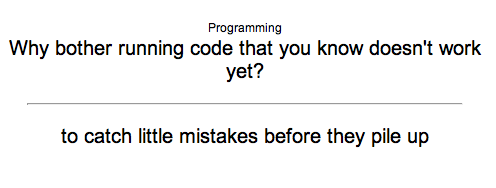
An aside: taking snapshots with the intent of making them public is a really good way to catch mistakes.


Sanity Checks:
Ask [programmer friend] to look over my cards
Try the following the "recipes" on a practice programming problem
Ask people on my blog for feedback
Followups:
Observe how many cards I've deleted, marked, suspended, or edited in three months.
I hit my comprehension limit partway through, maybe read it again after I've reviewed the deck.
----UPDATE July 11, 2016:
4 months later, I still have 49 cards. I've modified 31 of them. Here is the Revised Deck.
March 15, 2016
What's a good metacognitive mirror for defeating self-loathing?
Someone asked that question on a forum I frequent, and I thought I'd share my answer here.
First, what is a metacognitive mirror?
People have bias. We sometimes have ulterior motives nudging our decisions in certain ways, a kind of bias we're all aware of, and our perception of the world also develops some quirks based on the way our brains work. (See Kahneman and Tversky)
For example: we tend to question evidence that confirms our beliefs less harshly than we question evidence that disproves them. Counteracting this can be as simple as pretending you started out believing the opposite, and asking yourself how you feel about the evidence then.
Some problems like this take more effort to root out than others. Some of them actively work against our ability to notice and overcome them.
For example, feeling angry.
A lot of heated discussions go much more smoothly as soon as one or both parties take a breather to calm down. But the angrier you feel, the less you notice the ways that your anger works against you. Sometimes you can be in the middle of an argument, shouting "I'M NOT ANGRY" and barely even notice the contradiction.
Another example, getting drunk
We know alcohol causes a slower reaction time and impulsive decision making. There's good reason not to drive or make important decisions while under the influence. Unfortunately, judging whether you're too impaired to do something is also a decision, and it's negatively affected as much as any other.
Another example, getting drunk
We know alcohol causes a slower reaction time and impulsive decision making. There's good reason not to drive or make important decisions while under the influence. Unfortunately, judging whether you're too impaired to do something is also a decision, and it's negatively affected as much as any other.
What's that about self-loathing?
When you hate yourself, you can twist *anything* that happens into evidence that you are an awful person. Any mistake is unforgivable, anything good could have been better. You develop very distorted beliefs about your own abilities, what other people think about you, and what is or isn't worth doing. An astute self-hater may even notice the distortion of their thinking and proceed to beat themselves up for not having fixed it.
A litmus test on par with breathalizers for alcohol: Look yourself in the eye in a mirror and say that you're a worthwhile person.
It's stupid and corny, but it's seriously just words. If you find yourself flinching away from a simple exercise like this then your judgment is likely affected in less immediately visible ways too. Other tells: avoiding eye contact, talking faster, touching self nervously, exaggerating your words or voice or movements, nitpicking over the technicalities of your claim, making excuses not to do it another time, etc. It's like Gendlin-style Focusing.
You can combine the mentality of this with body mindfulness; notice that your body exists and spread yourself out to physically lay claim to all the space you can afford yourself.
You can especially benefit from noticing why you aren't trying both of these *right now*.
March 7, 2016
Political campaigning: Some California Ballots
TLDR: I checked Ballotpedia, and can give soundbites but do not significantly less confused about politics than I was before.
I saw a poster advertising paid political campaigning and called in on a whim.
Well, 70% whim - 20% intentionally pushing my comfort zone - 10% pleasegivemeajobIwantmoney
Motivation: If something comes of the interview they set up tomorrow and I go campaigning for spare cash, I want to know what I'm pushing. I'm not okay with making the world a worse place because I couldn't be bothered to do even rudimentary fact-checking. I think plenty of people prefer to hear an honest case, and *I* prefer to not look like an ignorant idiot whenever someone asks me an off-script question.
Question:
What initiatives did the guy on the phone bring up, and do I support them?
Method:
Google keywords mentioned (Prop 40 education tax extension, Water bond 2016, Tobacco tax to medical)
Find out that's not specific enough to find recent things, so look up recent stuff on whatever wiki-ish site that I find other propositions on.
Sources:
sources: https://ballotpedia.org/Potential_2016_ballot_measures#California
the notes I took during the phone call
(That was a good call, grabbing that notebook at the last minute!)
Answer:
Tax Extension to Fund Education and Healthcare Initiative
An Income tax increase in 2012 (on 250k bracket) gets 12 extra years, the funds from this increase go to schools and healthcare. Guy on phone suggested this is their focus
I think this likely fails to solve underlying problems with the education system and, dependent on how that tax bracket plays out it practice, possibly shits on entrepreneurs who *would* have helped solve the issues. I wonder where the money was going before.
Water Supply Reliability and Drought Protection Initiative
$6 billion in bonds for water supply infrastructure. Cost to local gov money maybe ~3x more than it saves. ($300 vs. $100 mill annual average)
Infrastructure is important I think. I'd vote yes and hope that someone else was paying attention to the implementation details.
Healthcare, Research and Prevention Tobacco Tax Amendment
Increase cigarette tax to $2/pack, with equiv. measures on other tobacco products and electronic cigarettes. Allocate revenues to healthcare and tobacco-related stuff. If biennial audit suggests this tax is decreasing tobacco use that other anti-tobacco programs rely on, transfers tax revenues to offset them. Supposedly a net revenue increase of $1-1.5 billion in next few years, decreasing in later years.
Generally for, but suspect diminishing returns on this sort of stuff. The offset worries me, not sure how the incentives shake out. Also curious what the consumer cost of cigarettes works up to nowadays. What programs ostensibly prevent taxes like this from just penalizing addicts cuz they're acceptable targets, and do they work?
Sanity Check:
Google if bonds are usually a good idea
How much of a marginal difference would a campaigner even make to the outcome, is it worth *refraining* from?
Ask [name] or [name] to research this shit
Reverse check - What are the biggest problems in California? Do these initiatives have any effect whatsoever on those problems or is it mostly opportunity cost at stake?
Have we tried talking to someone in the $250k bracket about their lifestyles and the taxes they pay?
Followup:
Talk to the interview guy
Read the whole proposal texts with a highlighter and red pen
Look up proposition 40, try to find the connection to the tax extension
I saw a poster advertising paid political campaigning and called in on a whim.
Well, 70% whim - 20% intentionally pushing my comfort zone - 10% pleasegivemeajobIwantmoney
Motivation: If something comes of the interview they set up tomorrow and I go campaigning for spare cash, I want to know what I'm pushing. I'm not okay with making the world a worse place because I couldn't be bothered to do even rudimentary fact-checking. I think plenty of people prefer to hear an honest case, and *I* prefer to not look like an ignorant idiot whenever someone asks me an off-script question.
Question:
What initiatives did the guy on the phone bring up, and do I support them?
Method:
Google keywords mentioned (Prop 40 education tax extension, Water bond 2016, Tobacco tax to medical)
Find out that's not specific enough to find recent things, so look up recent stuff on whatever wiki-ish site that I find other propositions on.
Sources:
sources: https://ballotpedia.org/Potential_2016_ballot_measures#California
the notes I took during the phone call
(That was a good call, grabbing that notebook at the last minute!)
Answer:
Tax Extension to Fund Education and Healthcare Initiative
An Income tax increase in 2012 (on 250k bracket) gets 12 extra years, the funds from this increase go to schools and healthcare. Guy on phone suggested this is their focus
I think this likely fails to solve underlying problems with the education system and, dependent on how that tax bracket plays out it practice, possibly shits on entrepreneurs who *would* have helped solve the issues. I wonder where the money was going before.
Water Supply Reliability and Drought Protection Initiative
$6 billion in bonds for water supply infrastructure. Cost to local gov money maybe ~3x more than it saves. ($300 vs. $100 mill annual average)
Infrastructure is important I think. I'd vote yes and hope that someone else was paying attention to the implementation details.
Healthcare, Research and Prevention Tobacco Tax Amendment
Increase cigarette tax to $2/pack, with equiv. measures on other tobacco products and electronic cigarettes. Allocate revenues to healthcare and tobacco-related stuff. If biennial audit suggests this tax is decreasing tobacco use that other anti-tobacco programs rely on, transfers tax revenues to offset them. Supposedly a net revenue increase of $1-1.5 billion in next few years, decreasing in later years.
Generally for, but suspect diminishing returns on this sort of stuff. The offset worries me, not sure how the incentives shake out. Also curious what the consumer cost of cigarettes works up to nowadays. What programs ostensibly prevent taxes like this from just penalizing addicts cuz they're acceptable targets, and do they work?
Sanity Check:
Google if bonds are usually a good idea
How much of a marginal difference would a campaigner even make to the outcome, is it worth *refraining* from?
Ask [name] or [name] to research this shit
Reverse check - What are the biggest problems in California? Do these initiatives have any effect whatsoever on those problems or is it mostly opportunity cost at stake?
Have we tried talking to someone in the $250k bracket about their lifestyles and the taxes they pay?
Followup:
Talk to the interview guy
Read the whole proposal texts with a highlighter and red pen
Look up proposition 40, try to find the connection to the tax extension
Subscribe to:
Posts (Atom)