Showing posts with label proof of work. Show all posts

July 22, 2016

How easy is it to just get outside of the house? An experiment.

Exercise is probably one of the highest value wellbeing interventions one can apply ot their life[citations needed]. It's sure a lot easier to get errands done when I'm already planning to be out and about. Not to mention, I live in a temperate coastal city with pleasant weather and scenery that merits enjoying.

How easy is it to just get outside of the house? An experiment.

I noticed I resisted decision/preparation timeouts in leaving the house. I thought I could train a discrete progression of actions (remember, decide, get ready, GO!) and turn it into a keystone daily habit that I can make other plans around.

Starting March 22, I decided that if I noticed I had no plans to leave the house, I would use the next break to step outside and wander a bit.

Data

Review Apr 8 - The "breaks" I take are not discrete, actually. I'd forgotten about this. I made a ritual habit to venture outside at noon every day instead.

Todo Notes Apr 11 - I haven't used my scooter in a while. Instead, I got rides with my romantic partner. The sky got cloudy and rained over the weekend. Fat chance I was going outside in that.

Review Apr 29 - Over the past week I have gone on multiple walks, 2 drives, and to lunch with a friend. I'm not really paying attention to this anymore; whether I do anything about it is highly dependent on my mental state.

Conclusions

This provided some useful information. When I am in a good mental state, I'm willing and ready to try to solve problems. Readiness to leave the house comes as a natural extension of this. With this in mind, I conclude that I need to improve my mental state in general.

Followup

I threw some trigger-action habit flashcards in my anki deck to cover some 80% of situations that tank my mental state, and these have been in action to varying success since April.

---
Was this a nice read? Does this seem like something worth performing for yourself? I would greatly appreciate it if you took a couple seconds to comment yes or no.

July 16, 2016

What python topics do I most consistently need to look up? An experiment.

A programmer's lament: Looking stuff up sucks.

I want better indexed docs. In the interest of this, I decided to do a little experiment. I wanted to figure out what, exactly, out of all the docs I looked up are important to have within reach.

What python topics do I most consistently need to look up?

I decided I would trawl my chrome history for programming-related pages.

Data

I noted in my strategic review* that I'm confused about which functions are built into python and which are class/library functions.
*(strategic reviews are when I periodically overhaul my to-do list, making a record of my successes and failures and checking in with my longer-term goals.)

Conclusions

The areas I want to focus on are:
  • string methods, formatting
  • file input/output, incl. json
  • git manipulation
  • exception handling
  • regex syntax
  • javascript syntax
  • postgres setup, syntax

Followup

Sanity Check
- Examples dominated by what I've spent time on. What have I *skipped* doing because I didn't even know where to start? noted in strategic review that I'm confused about what fns are built into python


Things I could do next:
  • Create Incremental Reading cards for docs/101 tutorials on
    • string methods, formatting
    • file input/output, incl. json
    • git manipulation
    • exception handling
    • regex syntax
    • javascript syntax
    • postgres setup, syntax
--

Was this a nice read? Does this seem like something worth performing for yourself? Take a couple seconds to comment yes or no!

July 15, 2016

Do I make progress on projects if I stick to 5 minute stubbable code functions? An experiment.

"ADHD is really executive function disorder" - Russell Barkely

The quote in the best talk ever made about ADHD goes something like that. In my quest to overcome this and learn how to actually get things done, I've tried many things. This is one of those tries, and I welcome you to read along with my adventure:

Do I make progress on projects if I stick to 5 minute stubbable code functions? An experiment.

I want to actually finish a programming project. But how? I took to the internet to find some inspiration, and found a Systematic Program Design Course with what seemed like a good system.

I gathered up the materials and set myself an experiment. I would try 5 to 10 rounds of attempting stupid tiniest chunks of email automation or website code (those being the projects I felt invested in at the time) in only 5 minutes. A significant part of my aim will be to make each function "stubbable"—that is, it returns a value such that the code is executable even if not correct.

If this is a good method of making progress on my projects, I expect my code to go off on an occasional tangent but for the functions to retain enough isolation to be fixable.

Below, I summarize the specific issues rather than include embarassing detail.

Data

Mar. 21 - None of the parts I created actually do what I need yet.
  • 5 tries so far on email automater.  
  • 2 functions stubbed,  
  • 1 function deleted.  
  • 4 function tests.
  • Issues
    • 13 complications
    • 9 information errors
    • 9 objectives failed
    • 3 uncategorized errors


Mar 22 - tried to make an website code stub, the result was invalid.
  • Issues
    • 1 complication
    • 2 information errors
    • 2 objectives failed

Mar 25 - copied a function from website, made an instance function, made a new class. Spent a while on planning which components I'd need, then made a new class. Got sucked into looong work instead of stubbing, bad idea.
  • Issues
    • 3 complications
    • 3 information errors
    • 4 objectives failed
    • 2 meta-issues

Mar 26 - starting over with wishlist of components for a log parsing utility.
  • 3 functions,
  • 5 stubs,
  • 5 tests.
  • Issues
    • 2 complications
    • 4 information errors
    • 6 objectives failed

Mar 27, 28. worked on programming, mostly doing big pieces trying to force sequential progress. I think I really benefitted from the pieces already built, and that I made faster progress when I kept to the spirit of the chunking strategy. Not bothering trying to record issues on this, too scattered.

Review Apr. 8 - I quit sticking to the 5min thing, but spent a bit of time working out chunks to work on. I'm going over the timers I set even then, esp. with issue hunts.

Conclusion

Yes this helps, but with caveats. Stuff gets done if I time-constrain myself on making stubbable functions, *including* separate time-constraints on the functions to test other functions.
Followup
I continued to use this method to break down my work in projects, and am just now sharing this experiment on my blog.

After an experiment I always take a few minutes to think of Sanity Checks: These are other quick experiment ideas (ideally taking less than five minutes)
  • How much can I actually type at mozy speed in 5min?
  • Estimate how long it'd take me to refactor a data type throughout a medium-sized project.
  • Time myself on refactoring the log parser to look nice
  • Fermi estimate time wasted on a project because of having to look stuff up and verify syntax. 
Compare to time wasted hunting down accumulated errors for lack of a good feedback loop. Which is actually likely to be the bottleneck?

I rarely the time to do the followup tests I dream up, but I consider it good practice to habitually consider what being plausibly, identifiably wrong looks like.

----

Was this a nice read? Does something like this experiment seem worth performing for yourself? Take a couple seconds to comment yes or no!

April 2, 2016

Testing: How much could I learn on Rosalind.info?

Hello, internet!

If you're curious what I get up to with my time, observe! I ran a little experiment today. This post reports it in a hodgepodge mix of "personal notes" and "terse scientific report".

If you take thirty seconds out of your day to comment, I will owe you one. Please encourage the norm of testing everyday ideas empirically; Be my miniature peer review.

How much would rosalind.info teach me?

I want to know the holes in my knowledge. If Rosalind actually helps, I want to train my internal motivation to prioritize working on it.

Hypothesis:

I currently can't do ~70% of problems. My learning trajectory looks unlikely to increase my capability beyond ~%50.

Method:

Experiment as proposed Mar 28 - count how many rosalind.info project list I can't do and how many I likely won't learn

Resources:

Rosalind Problems Lists
glimpses at other references for algorithmic and data structure fundamentals

Results:

Apr 2: I ignored Biology Content Knowledge, except where the lack of deep understanding seriously impedes my ability to program the solution.

PYTHON VILLAGE 1:0:0
  • 6 understand
BIOINFORMATICS STRONGHOLD 1:1:5
  • 13 understand
  • 14 don't understand yet
  • 78 doubt I'll cover
BIOINFORMATICS ARMORY 2:1:4
  • 4 understand
  • 2 don't understand yet
  • 9 doubt I'll cover
BIOINFORMATICS TEXTBOOK TRACK 1:2:4
  • 16 understand
  • 39 don't understand yet
  • 70 doubt I'll cover
ALGORITHMIC HEIGHTS 3:4:1
  • 12 understand
  • 18 don't understand yet
  • 4 doubt I'll cover
TOTALS 2:3:6
  • 51 understand
  • 73 don't understand yet
  • 161 doubt I'll cover

Conclusions:

Technically speaking, Rosalind wouldn't teach me anything. It has practice problems and a minor amount of scaffolding; designing the solution remains up to me.

Rosalind can sharpen my current skill set some, and do a little more to stretch my limits (mostly in graphs). The vast majority of problems deal in bioinformatics-specific knowledge. If I want to focus on that, the "Bioinformatics Armory" set works would shore up relevant foundations while not wasting time on general skills. This accords with its stated purpose.

Python Village and Algorithmic heights make okay sources for general practice.

Sanity-checks:


  • talk to an actual bioinformatics researcher, ask what they do and what tools they're using
  • try this experiment on an actual programming practice book, or a fundamentals checklist for comparison
  • google search for "waste of time rosalind.info" and "helped me rosalind.info", see if I can get some user experiences for how much it has helped other people
  • what does ONET say about the career outlook if I did decide to work in bioinformatics?
  • spend 5 minutes thinking about ways I could leverage bioinformatics domain knowledge in my other goals

Followups:


  • Trawl the Rosalind problems for Anki cards
  • Throw the glossary into Anki
  • Share this feedback with rosalind.info

March 19, 2016

An Experiment In Morning Blues

Hello friends!

If you're curious what I get up to with my time, observe! I ran this little self-study over the past couple of weeks. This post reports it using a hodgepodge style somewhere between personal notes and a scientific paper.

If you want to encourage the norm of testing everyday ideas empirically, or just do me a solid favor, please be my mini peer-review and take a moment to comment.

~*~

When I have a bad morning, the rest of the day's productivity seems to get shot and that feels bad. I set out to do something about it.

Question: What are the key factors in having a pleasant morning?

Hypothesis: Happiness will correlate with getting dressed and eating food and getting sunlight. I expect I can manage those things more easily when I'm in a good mood.

Method: For 15 mornings, I recorded when I did one of a set of things on the whiteboard. Collected "Happy, get sunlight, get dressed, get water, eat food, noise control". Looked for visual correlations. Checked straight predictive accuracy.

Results:

sorry blind people i'm lazy

Dashes in the first image mark a wholly blank day.

The second image is some summary data of the first.
Counts: True positive, false negatives, false positives, true negatives for each column.
Below that: Accuracy, precision, sensitivity (recall) for each column

Conclusions:

  • Noise control may help a bit. Nothing else looked like an especially accurate predictor of mood.
  • Eating in the morning may anti-predict feeling good.
  • Getting a drink might be a sensitive enough mood test to use as a Trigger Action for exploiting them.
Sanity checks:
(This is a new section in my notes, added to encourage me to notice whether my ideas could be wrong in a way that would have take embarrassingly little effort to find out. If you can facilitate one of these sanity checks, please let me know!)

  • Ask someone who can Real Science(tm) to calculate my result's p-values.
    • Common sense-wise, I had 5 happy mornings recorded to work with. All of my conclusions are based on, like, a difference of 1 data point.
  • Check correlations between the variables themselves.
  • Take a mood test with one of clearerthinking.org's tools at several different times before 11am. If I get a wide variance and/or the empirical-ish results differ from my overall self-report then my results are probably bogus.
  • Search google scholar for studies about morning routines and read the abstracts
  • Test whether I get carb crashes. Food does have a plausible mechanism for causing a negative effect.
  • Ask autistic tumblr how they tweak their morning routines to prevent overload.
Potential Follow-ups:

  • Try this again when I'm not sick
  • Trigger Action Plan: With a drink in my hand, free associate thoughts about stuff I need to do.
  • Practice making/importing data into R
  • Spend a week or two collecting a more representative sample of things I do in the morning, run another self-study with those.

March 16, 2016

Anki Deck for Systematic Program Design

I want to know what skills I can work on to write elegant code. In particular, I want to know the secret sauce to making a comprehensive project I can show off to people

Methods: I searched an edX course's materials for some causal intuitions I could reinforce. (Background understandings, like "If I get X right then Y will go a little more smoothly".) I then stuck my insights into an Anki deck to be digested at a later date.

Results: Anki Deck on Google Drive (UPDATE: 4 months later Revised Deck)

Good cards require personalization. Results may vary.

Random sample 4/49 cards
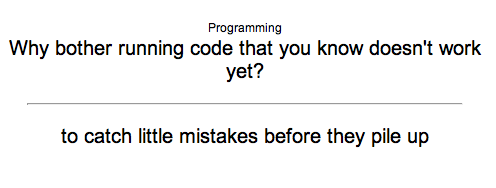
Anki card: Why bother running code that you know doesn't work yet? ... to catch little mistakes before they build upA self-referential type must have at least two cases: a reference and a base case.Anki card: when should I first try to run my program? ... as early as possibleAnki Card: Function stub means... a dummy function that returns the right type value. e.g. def add_numbers(n1, n2): return 0
An aside: taking snapshots with the intent of making them public is a really good way to catch mistakes.

Sanity Checks:
Ask [programmer friend] to look over my cards
Try the following the "recipes" on a practice programming problem
Ask people on my blog for feedback

Followups:
Observe how many cards I've deleted, marked, suspended, or edited in three months.
I hit my comprehension limit partway through, maybe read it again after I've reviewed the deck.

----UPDATE July 11, 2016:
4 months later, I still have 49 cards. I've modified 31 of them. Here is the Revised Deck.

March 7, 2016

Political campaigning: Some California Ballots

TLDR: I checked Ballotpedia, and can give soundbites but do not significantly less confused about politics than I was before.

I saw a poster advertising paid political campaigning and called in on a whim.
Well, 70% whim - 20% intentionally pushing my comfort zone - 10% pleasegivemeajobIwantmoney

Motivation: If something comes of the interview they set up tomorrow and I go campaigning for spare cash, I want to know what I'm pushing. I'm not okay with making the world a worse place because I couldn't be bothered to do even rudimentary fact-checking. I think plenty of people prefer to hear an honest case, and *I* prefer to not look like an ignorant idiot whenever someone asks me an off-script question.

Question:
What initiatives did the guy on the phone bring up, and do I support them?

Method:
Google keywords mentioned (Prop 40 education tax extension, Water bond 2016,  Tobacco tax to medical)
Find out that's not specific enough to find recent things, so look up recent stuff on whatever wiki-ish site that I find other propositions on.

Sources:
sources: https://ballotpedia.org/Potential_2016_ballot_measures#California
the notes I took during the phone call
(That was a good call, grabbing that notebook at the last minute!)

Answer:
Tax Extension to Fund Education and Healthcare Initiative
An Income tax increase in 2012 (on 250k bracket) gets 12 extra years, the funds from this increase go to schools and healthcare. Guy on phone suggested this is their focus

I think this likely fails to solve underlying problems with the education system and, dependent on how that tax bracket plays out it practice, possibly shits on entrepreneurs who *would* have helped solve the issues. I wonder where the money was going before.

Water Supply Reliability and Drought Protection Initiative
$6 billion in bonds for water supply infrastructure. Cost to local gov money maybe ~3x more than it saves. ($300 vs. $100 mill annual average)

Infrastructure is important I think. I'd vote yes and hope that someone else was paying attention to the implementation details.

Healthcare, Research and Prevention Tobacco Tax Amendment
Increase cigarette tax to $2/pack, with equiv. measures on other tobacco products and electronic cigarettes. Allocate revenues to healthcare and tobacco-related stuff. If biennial audit suggests this tax is decreasing tobacco use that other anti-tobacco programs rely on, transfers tax revenues to offset them. Supposedly a net revenue increase of $1-1.5 billion in next few years, decreasing in later years.

Generally for, but suspect diminishing returns on this sort of stuff. The offset worries me, not sure how the incentives shake out. Also curious what the consumer cost of cigarettes works up to nowadays. What programs ostensibly prevent taxes like this from just penalizing addicts cuz they're acceptable targets, and do they work?

Sanity Check:
Google if bonds are usually a good idea
How much of a marginal difference would a campaigner even make to the outcome, is it worth *refraining* from?
Ask [name] or [name] to research this shit
Reverse check - What are the biggest problems in California? Do these initiatives have any effect whatsoever on those problems or is it mostly opportunity cost at stake?
Have we tried talking to someone in the $250k bracket about their lifestyles and the taxes they pay?


Followup:
Talk to the interview guy
Read the whole proposal texts with a highlighter and red pen
Look up proposition 40, try to find the connection to the tax extension

March 5, 2016

Goal setting

An incomplete list of stuff I'm up to

Alumni Pair Debugging
Some in my community express feelings of extreme loneliness and ineffectiveness at times. To counteract both of these, I started a service to pair people up regularly to troubleshoot their problems together. I engineered the system to stay stable and low-effort from the start so they could rely on its continuation; now I'd like to expand its scope. I will gather data on how people engage with the system now, experiment with ways to alter the service to better serve people's needs, and bring more members on board.

Make Anki Useful Again
Spaced repetition has a lot of evidence supporting its usefulness, and I made extensive Anki decks on hoping to capture that value. In time, I learned that to use that value I had to respect its limits; efficient memorization could not replace proper *understanding* and *prioritization*. I will clear out decks not relating to current or projected objectives and alter my current reading followup system to take advantage of the incremental reading plugin.

Trends and Disagreements in the Rationalist Community

Edited from my personal notes format again.

Question: What are the trends and disagreements in the rationality community this month?

Motivation: I want to know what's up, and I want to make a difference. Avoiding the valley of bad rationality seems useful. Also the community has a distinct motte-and-bailey going on about whether rationality means "whatever wins" or the flavor of the LW sequences and diaspora.

That's a fine thing to have, in one direction: we can talk about our latest and greatest ideas, play with those flavors, invite others to join in, and when we encounter disagreement we should rightly take a step back into our core principles to ask "Wait, is this actually what wins?"

But I sometimes see it happening the other way: using the "whatever wins" banner as an enticement to get others to join in, and use our supposed intentions as a general defense for our methods. Methods we aren't centralized enough to even all agree on.

Method: Look at some major blogs. Give a quick summary of each and try to name our felt sense about a) how authoritative they are and b) whether they agree with each other.

Sources: Lesswrong Main, Lesswrong Discussion

Answer: Lesswrong main: seems to navel-gaze lately. It rehashes. It struggles to curate itself. Latest posts are Meetups, trying to distill CFAR stuff, estimating the value of people in Effective Altruism, LW karma charts, speculating about medical conditions, gamifying goals.

LW discussion: I see people chatting about LW's decline, but what do they do about it? I see continued argument about the place for politics and productivity hacks.

AI fermi paradox speculation. They make a background assumption that FAI is hard, unsurprisingly.
AI safety. Using analogies to the past, notable inability to bridge inferential gaps with people out of the OB/LW sphere

High school advice: Get GED and skip to college, or leverage private school. Get college's large wealth and power boost. Meta advice: break down skills important to making choices in
general (value awareness, prediction accuracy, agency) and check that you're stacking your character.

Media to follow... gwern's recommendations well-received

PSA about air quality, gathering what-should-be-universal statistical literacy, trying to propagate lists of high-value PSAs in general

Disagreement: is altruistic deception necessary?

I'm nowhere close to done but I'm way over time.

Sanity-check:
LW is decidedly not the zeitgeist, and it knows it's not.

People are complicated, reality is complicated, it would be surprising to have succint summarizations.

Could I do a poll of what people read, what 'tenets' people work with? What such polls already exist?

Have I spent five minutes actually imagining what a group both coordinated and flexible enough to all change their minds on a dime would actually look like?
.... Damn, it would look like the mormon church.

Followups:
Featured/Promoted: try to establish what canon is well-known at the moment

Refine what it is I'm looking for.

Old LW surveys, SSC surveys, see if gwern does surveys

This tumblr post by Scott Alexander about rationalist tumblr

January 16, 2016

Nice things for a struggling friend

In this post, I will experiment with modifying my personal research notes to a sane, shareable format.

These notes have a story to them. A while back, I stumbled upon a piece of brilliant advice: “Here’s how to write your thesis without suffering: every day, write down an experiment you ran and record the result, even if all you did was answer a question using a Google search”. Working with ideas as coherent and novel as theses and sharing them with the world excites me, I figured that writing down the results of my google searches really WAS the least I could do towards that goal.

I admit, this example does not lend so well to sharing. My personal version contains more specific  and identifying information which I'd prefer not to share. I edited this version to showcase a more general solution.

Question: 

What are some nice things I can do for a struggling friend?

Motivation:

I have a friend I predict is having a not-so-great time right now.  I know from personal experience and reading many blog posts about secular grief that "Ask me if you need anything" generally doesn't lead anywhere. They might feel uncomfortable asking. Even without awkwardness, it's a hard task figuring out what exactly people can help with.

Method:

Google, alter query as needed

Sources:

Here I would generally include links and describe blurry recollections of where I'd gotten the supporting notions. I will not include links in this version since they relate to a specific, maybe identifying, problem.

Many secular blog posts about grief - When you do things to actually assist an overwhelmed person, they remember even the smallest instances more vividly and warmly than all of the kind words.

The concept of 'next actions' from Getting Things Done, and expansions on the idea from CFAR - Tasks you aren't sure how to act on leave an open loop running in your head, sapping your attention.

Personal experience - I flailed about helplessly, wishing beyond hope for someone to do something, and could think of nothing to say when anyone asked what they could do to help. When I make a vague suggestion to a friend, the ensuing back-and-forth often gets interrupted before going anywhere.

Answer:

TAKE INITIATIVE, as I already knew. Do stuff like "I'll be over at 7 pm Friday to pick you up and treat you to dinner," rather than "So maybe we should do dinner sometime..."

Seek them to hang out with, they may try to isolate.
Specifically: invite them personally to social events you know about. Offer them a ride places. Take them out to lunch or coffee. Call them up or IM them.

Reach out to talk with them after anything biggish.
Specifically: A birthday or anniversary of someone they lost. Filing taxes, paperwork. Kids just left back to ex-spouse's house. First date. Anything big enough that they brought it up in your last conversation.

Do something physical, exercise is the classic anti-depressant.

Cook a meal to deliver. Drop by to help with chores, groceries, dinner.  Help clean the house.

Send an email, share something from the web, let them know that you were thinking of them

Follow-up ideas

How do I even find out where my friends live?

Can I generalize this solution? - I did... for this post.

Try with a few friends, see if it actually works.

What's the likelihood of this backfiring horribly?

Send an email 'following up' our last visit with a random Reddit in the postscript

August 24, 2014

Alright, so the gist of the thing is that I'm pulling a Gwern.

A while back, I decided I was going to start journaling.


I had a journal to do it in and everything, and carried it around pretty consistently. Eventually I did get into the habit of actually writing in it.

A month or so passes by. I notice, "Hey, wouldn't it be neat if I recorded some specific stuff so I could get a sense of cause and effect in my life?" So I start being a bit more strategic in my writings:

  • I get an alarm for my phone that goes off at random intervals. While the majority of the time I don't notice it's going off, it's still nice to have some criteria for when I write in my journal that's slightly biased towards when I happen to feel like writing in it.
  • The other thing I did is start getting serious about time-keeping. I created a column in each page specifically for writing the time when I make a note. I created another column for specific observations that I'm trying to track, e.g. what I ate for breakfast, what time I went to bed/woke up, what mood I'm in, what medications I took. It was all so very clever, so at this point I'm as pleased as punch.
  • I also start doing weekly reviews. I write one review in my journal, and one on the lesswrong site. They cover slightly different topic areas; My journal review tends to cover personal events I may need to refer to in posterity, while the group diary post concentrates on specific interventions I've been trying. I also have monthly reviews in my journals. Neither of these are particularly good at capturing the patterns I've been attempting to set up with the different columns shenanigans.
Fast forward to last weekend. I am at a reunion for the CFAR workshops I went to two years back, and am suddenly surrounded by people who strive to be competent in intelligent ways. This attitude is very contagious.

I look at my journal and realize that a.) I completely fail to fill it out when I am very depressed or very busy and b.) I am not actually getting what I wanted out of the myriad improvements I'd taken on. When someone asked what I like to do, or what I've done, my mind drew a blank the same as it always has. This is despite the fact that I do weekly reviews like clockwork, where I literally go back and read about the things I've done over the past week to summarize the interesting bits. If you asked me what the effects of diet or melatonin have been on my days, I would wind up giving you a wishy-washy "well, it kinda feels like it's done this......" answer that is only marginally better than what if I'd had a normal person's memory and were making no attempt to objectively examine the problem at all.

Most importantly, I got the feeling that substantially more was possible.

So, I'm doing a trial.  I will take a small dose of melatonin nightly for a week, and take nothing for a week after. I am recording bed time, waking time, how I feel when I wake up, and length of naps. I intend to graph the data a couple of ways to get a better feel for what's going on.
  • time slept box plots comparing groups.
  • waking up feeling box plots comparing groups.
  • Time slept vs. waking up feeling for both groups
  • Time slept vs. waking up feeling for both groups including naps
  • nap lengths themselves vs. waking up feeling
  • nap times vs. time slept.
Depending on how these look, I will put together a linear regression model and see what pops out. I think it will be fairly interesting. I have strong doubts these will come out statistically significant, but I'm curious what will come out. And statistically significant or not, it's not ZERO evidence. I'm pretty confident already that melatonin makes me wake sooner, what I don't know is how it affects my morning mood or subsequent naps.

We'll see how the variance looks, and I can get a better idea of what N I'll need to do other self-trials. I would like to try this with reading affirmations in the morning. I could do a placebo that's just lorem ipsum text.

July 13, 2013

Soylent Not-Green is made of Not-People

TLDR;
Trying an advanced meal replacement shake. So far, Soylent = Best thing EVER.

Ever felt like food is just too much of a hassle? It seems like food is either easy or healthy. There might be a small overlap if you've got the money for it, I suppose. But is that not just another resource to expend in place of direct effort?

That's my opinion. Sure, there are times when a meal is delicious and fulfilling and an absolute delight in my day, but those are few and far between. Most of the time I don't care to seek out good food, I just reach out blindly for something to shut up my cravings or hunger signals, and let me plod along unhindered for another half a day. Hungry me cares about nothing but loading up on sugar, protein, and salt as fast as humanly possible. Pausing to think about something as banal as nutrition and long-term health concerns? Laughable. It's still necessary, I'm just in no state of mind to do it.

Figuring out what to eat is by and large an evil that I'm forced to contend with. I've known for some time now that planning for nutrition must happen ahead of time or it won't happen at all. I've been failing for most of that time too. I've failed miserably to successfully batch-plan meals, let alone batch-plan balanced ones. In a way, I'm lucky I even thought to have a jar of chocolates on my desk for buying coworker affection: I at least have something to get me through the day.

About a month ago, though, someone at a meetup mentioned something in passing that caught my interest. A guy named Rob Rhinehart had apparently been having similar frustrations, and decided, "Screw this diet thing, I'm just going to take the basic food constituents (protein, carbs, vitamins, minerals, etc.) and blend them all into a single shake." Which he then decided to call Soylent, because this guy has an excellent sense of humour, and he shared his experience in eliminating food from his diet on his blog.

I'm reminded of the brief spark of interest I had in intravenous nutrition back when I was studying to be a Pharmacy Technician. "Wouldn't that be convenient?" I thought, right before I remembered that that would involve needles and read on to find out there were issues with blood toxicity anyways.

Frankly, I'm surprised someone hasn't done this sooner. Or, alternatively, that I haven't run into more popular accounts of people trying this. Maybe I just don't run in the right circles. It's not like we don't already have protein shakes, and meal replacement bars, and metamucil, and V8, and vitamins, and dietary supplements up the wazoo. There probably are people who effectively subsist on milkshakes and/or coffee for weeks at a time, we might as well make it explicit and shoot for the most balanced version we can.

I finally got fed up with cooking enough to give it a shot. I bought everything on Amazon and started just last night with half the Poor Man's Recipe plus a dash of half and half. It was weird tasting. The vitamin juice adds an odd undertone to the chocolate protein mix. It was on the edge of my picky requirements for tolerableness, which in itself kept me drinking it as I kept trying to figure out whether it was actually tolerable or not. My stomach wasn't quite sure what to make of it. If it could talk, I'm sure it would have shouted "WHAT ARE YOU DOING WOMAN?!?"

I felt.. sorta sloshy. Sorta overfull too? I don't know how to describe it. It didn't settle for a long while, but I'm not totally surprised given the concentration of slow carbs and nutrients in comparison to my usual food. That feeling of not-quite settling was alarming, because that usually indicates upcoming nausea or vomiting. (Though ocassionally it only indicates gas.) It never progressed beyond the weird feeling, thankfully.

Other than that, I felt great! Like I could take on the world! If this is what people who have nutritionally balanced diets always feel like, I sorely regret not taking this area of life more seriously. I feel more present, sounds seem louder, and I feel the need to move and do. The energy was so atypical for me that, in combination with the stomach weirdness, I was mildly paranoid that I'd overdosed on potassium or something despite my carefulness and was about to go into a fit and die.

This paranoia was not helped by staying up till 10, waking up at 3, and still feeling absurdly energetic. (Albeit a little hungry for more.)

September 1, 2012

Penalty Post

You know what's a really good motivator? Public humiliation.

I knew this, and so I posed a self-challenge to my friend last week:
Let it be said right here that I WILL talk to my parents about setting aside an hour every Sunday or Tuesday for making lunches -and get a distinct yes or no commitment- or... or else I will take a picture of my horribly messy room and post it on my blog!
And guess what I did not do?

That's right, I did not get a distinct yes or no commitment. I posed the question, yes, and I even got a "yes" answer--that may be enough for some people, but it wasn't the standard I had set for myself. I had to get a commitment. My step-dad said "Sure, let's do that Sunday morning," but he'd suggested this right after musing about going to Costco to get some bread to make sandwiches. There was little chance that we would actually go to Costco early Sunday morning, and I knew it. He'd not thought through the logistics of it, which means he wasn't actually making a commitment. Sunday came and went, without even a comment on the lack of lunch-making.

So by my own standards, I failed. In accordance with my penalty, here are the photos:


(Luckily for me, Public Humiliation is a powerful motivator. I cleaned my room that very same weekend, just in case. You should have seen how much worse it was before.)

July 24, 2012

How Did We Get Up Here Again?


School project.

I was going to make the waterfall blue, except I printed it off before I remembered to. Somehow Mido's other hand got lost in the waterfall mist, I must have forgotten to merge that with the other Character layers before I moved stuff around.

The girl on the left is Quantum, the boy on the left is Mido. See my deviantart comics gallery for more of them.